 J. Vasc. Biol. 42, Sup:2 (2005) p43
Background: For chronic treatment with organic nitrates the development of nitrate tolerance and cross-tolerance were described. These phenomena may be explained by increased oxidative stress and by impaired bioactivation of the nitrates. Remarkably, pentaerithrityl tetranitrate (PETN) failed to induce nitrate tolerance and superoxide formation.
Methods: Wistar rats were treated with PETN by either infusion (400mM PETN, 1μl/h for 3d) or feeding (7mg/kg PETN/12h for 3d). Endothelial function was assessed by isometric tension recording and protein expression by Western blot analysis (P-VASP, sGC and HO-1). Reactive oxygen species (ROS) were measured by L-012-enhanced chemiluminescence. ALDH-2 activity was measured by HPLC.
Results: The PETN dose-response curve showed no significant difference between sham- and PETN-treated rats (irrespective of the administration protocol). Similar results were obtained for ACh- and GTN-dependent relaxation. Vascular HO-1 and sGC were significantly increased in PETN-treated animals. P-VASP, ROS formation and ALDH-2 activity showed no significant difference in control versus PETN-treated rats.
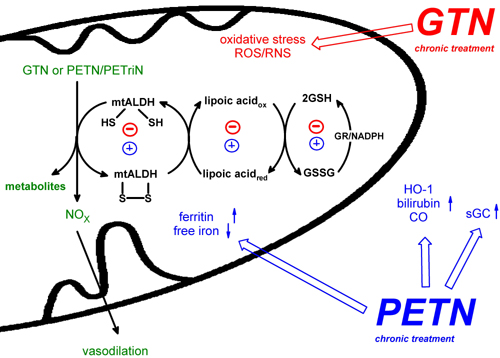
Hypothetic scheme explaining the differential tolerance phenomena upon chronic GTN or PETN treatment
Conclusions: High dose in vivo PETN-treatment in Wistar rats does not induce nitrate tolerance or cross-tolerance. This beneficial effect may at least partly be explained by induction of the antioxidant enzyme HO-1, by up-regulation of sGC, and by the lack of oxidative stress induction by PETN. These protective antioxidant properties of PETN may be of clinical benefit for chronic nitrate therapy.