Objective:
New generation totally subcutaneous ICDs (S-ICDs) were introduced in 2010 with constantly increasing implantation rates. Electro-magnetic interferences (EMI) are a well-known problem in patients wearing electrical cardiac devices. A study of our group revealed that transvenous ICDs1 as well as pacemakers2 may be at risk for EMI in close proximity of household appliances (e.g. a hand drill). However, S-ICDs acquire a different ECG (like a modified surface ECG) for detection and discrimination of the underlying heart rhythm. Thus, translation of results from transvenous ICDs is not possible.
New generation totally subcutaneous ICDs (S-ICDs) were introduced in 2010 with constantly increasing implantation rates. Electro-magnetic interferences (EMI) are a well-known problem in patients wearing electrical cardiac devices. A study of our group revealed that transvenous ICDs1 as well as pacemakers2 may be at risk for EMI in close proximity of household appliances (e.g. a hand drill). However, S-ICDs acquire a different ECG (like a modified surface ECG) for detection and discrimination of the underlying heart rhythm. Thus, translation of results from transvenous ICDs is not possible.
Given the potential harm of inappropriate high voltage shock delivery due to EMI, it is of critical importance to identify and control possible harmful electro-magnetic interferences with S-ICDs.
The aim of our in vivo study was to test if S-ICDs can be disturbed due to electric and magnetic fields (EMF) at power frequency of 50 Hz. Furthermore we aimed to characterize the device reaction on EMI.
Methods:
Patients were exposed to EMF using Helmholtz coils for generation of magnetic fields (max. 2550 μT) and an applied body current simulating an electric field exposure (max. 400 μA corresponding to 30 kV/m). Single magnetic, single electrical and combined fields were tested at different strength in a stepwise approach in 2 patients with S-ICDs (1 Boston Scientific Model Emblem A209 and 1 Cameron Health SQ RX Model 1010). Devices were programmed to all three sensing vectors (primary, secondary, alternate) and 1x and 2x S-EGM gain. Real time S-EGMs were recorded. Thus, allowing determination of interference thresholds.
Patients were exposed to EMF using Helmholtz coils for generation of magnetic fields (max. 2550 μT) and an applied body current simulating an electric field exposure (max. 400 μA corresponding to 30 kV/m). Single magnetic, single electrical and combined fields were tested at different strength in a stepwise approach in 2 patients with S-ICDs (1 Boston Scientific Model Emblem A209 and 1 Cameron Health SQ RX Model 1010). Devices were programmed to all three sensing vectors (primary, secondary, alternate) and 1x and 2x S-EGM gain. Real time S-EGMs were recorded. Thus, allowing determination of interference thresholds.
Results:
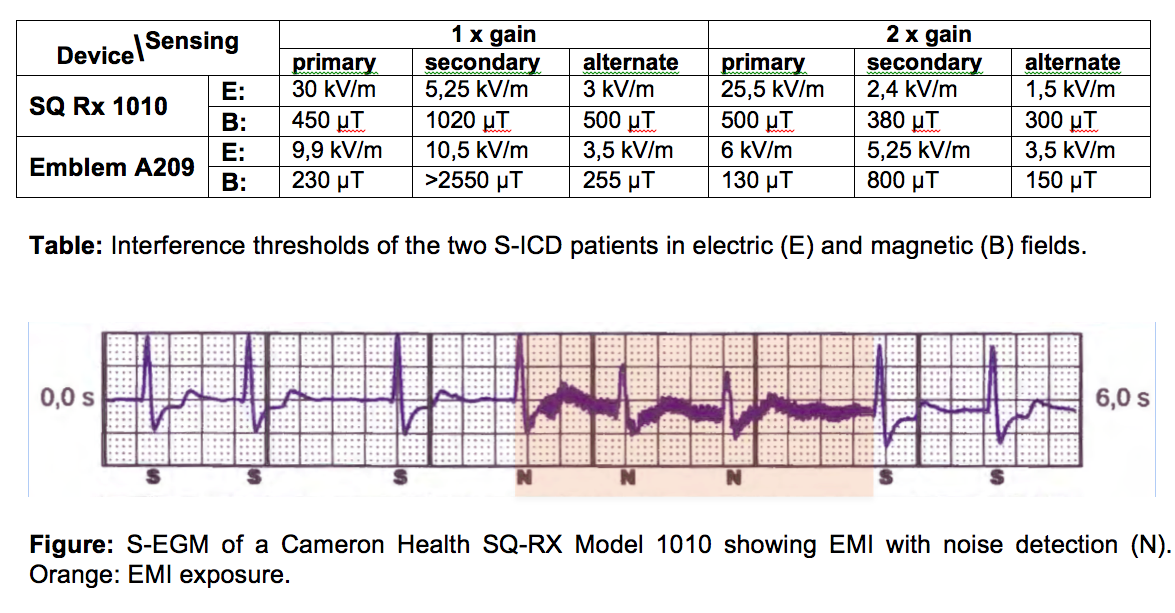
Interference thresholds are depicted in the table (combined field exposure not shown). All devices could be disturbed in the tested field ranges. All devices detected noise at the interference threshold (figure). Inappropriate tachycardia detection could not be observed.
Interference thresholds are depicted in the table (combined field exposure not shown). All devices could be disturbed in the tested field ranges. All devices detected noise at the interference threshold (figure). Inappropriate tachycardia detection could not be observed.
Conclusions:
Depending on the individual device programming interferences of S-ICDs in EMF are possible even in EMF of daily life exposure. E.g. some hand drills emit magnetic fields up to 2000 µT at the surface, which is far above the interference threshold of the S-ICD (table). In 50 Hz homogenous EMFs the primary device reaction was detection of noise and subsequent withdrawal of high voltage therapy delivery. Under these conditions VT/VF may not be detected which is comparable with the noise mode of transvenous ICDs.
Depending on the individual device programming interferences of S-ICDs in EMF are possible even in EMF of daily life exposure. E.g. some hand drills emit magnetic fields up to 2000 µT at the surface, which is far above the interference threshold of the S-ICD (table). In 50 Hz homogenous EMFs the primary device reaction was detection of noise and subsequent withdrawal of high voltage therapy delivery. Under these conditions VT/VF may not be detected which is comparable with the noise mode of transvenous ICDs.
These results indicate that patients with S-ICDs under strong EMF exposure are at risk for relevant EMI. Larger in vivo studies have to be conducted to determine interference thresholds and reveal predisposing factors for interference. Error memories and dedicated diagnostics should be implemented by the manufacturer.
Referenzen:
1. Napp A, Joosten S, Stunder D, et al. Electromagnetic interference with implantable cardioverter-defibrillators at power frequency: an in vivo study. Circulation 2014;129:441-50.
2. Stunder D, Seckler T, Joosten S, et al. In Vivo Study of Electromagnetic Interference With Pacemakers Caused by Everyday Electric and Magnetic Fields. Circulation 2017;135:907-9.
http://www.abstractserver.de/dgk2018/jt/abstracts//V171.htm